
Type that stays sharp.
Because it was never generated.
Every AI video model mangles on-screen text — it is painting pixels that resemble letters. Reigniter renders the words as real type on a deterministic clock, so a stat card, a price, a logo lockup or a UI walkthrough comes out legible at full resolution. It also calls no video model, which is why it costs a fraction of a generated clip.
A real render from this pipeline. Pause it anywhere and read the type.
A brief goes in. A composition comes out.
No timeline to learn, no keyframes to set — but the result is keyframed motion, not a slideshow of stills.
Describe the spot
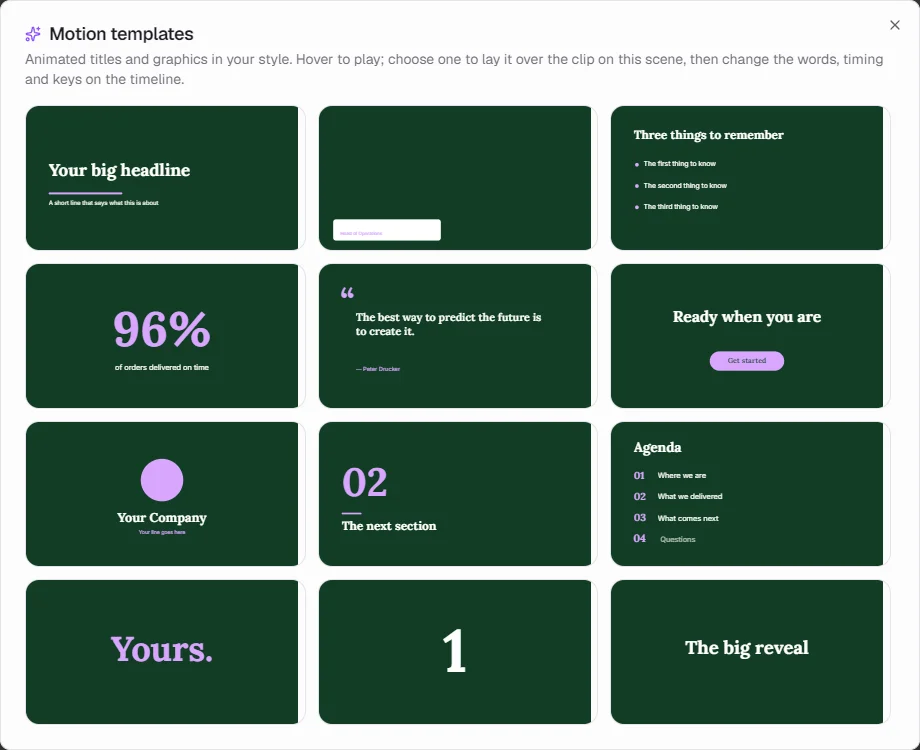
A brand, a claim, a call to action. The copilot writes the beats — hook, proof, CTA — and picks a motion template that fits the message.
It renders as code
The composition is HTML, GSAP and Three.js on a deterministic clock. Every frame is drawn, not sampled, so the same input always gives the same output.
Get a broadcast-ready MP4
1080p, 30fps, true 180° shutter motion blur.
The full motion-design vocabulary
Kinetic type, animated UI, data that counts up, 3D logo finishes, camera moves through a scene.
Words that carry the message
Per-word and per-character staggers, morphing headlines, typewriter reveals and stretched repeaters — driven by real easing curves, with true 180° shutter motion blur so fast moves read as motion instead of judder.
Frame-accurate at 1080p/30. Motion blur is sampled at 2–4× and averaged down, the same way film shutters work.
Interfaces that actually animate
Dashboards, charts and app screens that move: bars grow, numbers count up, a cursor travels and clicks. Each panel runs its own nested animation, so a screen full of UI feels alive rather than pasted on.
Glass, dispersion and depth
The logo finale is real 3D — physical glass material with transmission, iridescence and chromatic dispersion, lit by an environment map and finished with bloom. Rendered in the same composition as the type, on the same clock.
Every layer on a timeline, keyframed like After Effects
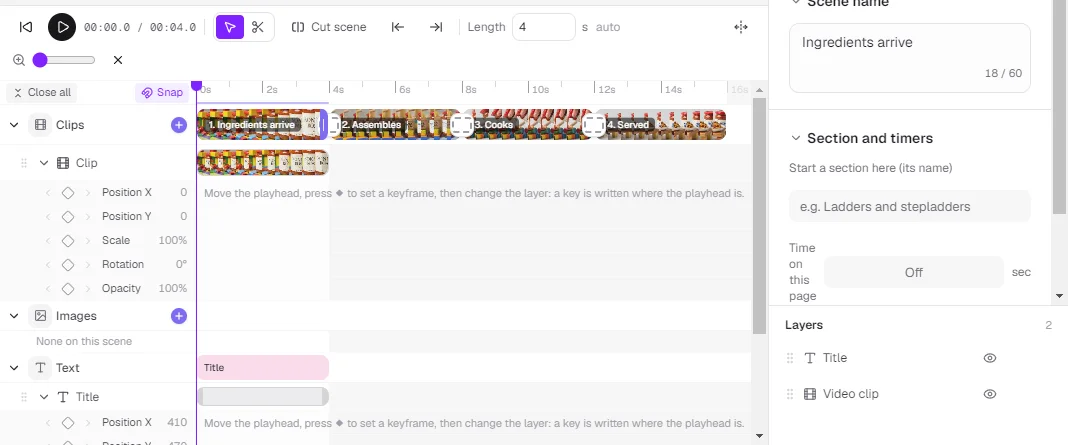
When you want the controls, open the Motion Editor: layers you can reorder and hide, keyframes on position, scale, rotation and opacity, and a timeline that shows when everything appears.
Deterministic beats probabilistic
The same brief renders the same film, every time. That is not a small thing when a client asks for one word to change.
Legible type, guaranteed
The words are composited as text, not sampled. There is no version of this pipeline that produces a warped letterform, because no model ever draws one.
Change one word, keep the film
Re-render and everything else is identical — same timing, same camera, same grade. A generative model gives you a different film each time you ask.
Compute-cost, not model-cost
No video model is called. The render is our own compute, which is why this is the cheapest scene type in the product rather than the most expensive.
Any aspect, one source
16:9, 9:16 and 1:1 come off the same composition with the type re-flowed into the safe band — not three separate renders you have to reconcile.
Mixes with generated footage
Motion scenes sit on the same canvas as cinematic, presenter and product shots, so one ad can open generated and land hard-typeset.
Built for volume
One composition plus a data feed becomes hundreds of localised or resized cuts — deterministic, reproducible, and identical apart from the fields you changed.
Everything below came out of this pipeline
Hover any tile to play it.
App / Dashboard Promo
Motion
Dashboard promo
App demo
Glass logo finale
3D finish
UI walkthrough
Product
Full brand film
Long form
Captioned UGC
Social
The things people ask first
Because it is not generated. A diffusion model paints pixels that resemble letters, which is why the type warps and the logo melts. Here the words are real text laid out by the browser and composited at full resolution, so a serif stays a serif at 1080p.
The output shape is comparable — that is the point, it is studio-grade motion design. The difference is that a template tool needs a human to place every layer, and this is driven from a brief: the Storyboard writes the beats, and every word is set as real type.
It calls no video model: the render runs on our own compute. That is why it is the cheapest scene type in the product by a wide margin. It is still billed in credits like any other render; see Pricing.
Yes. A motion scene is one scene type on the same canvas as cinematic, presenter and product-motion scenes, so a single ad can open on a generated shot and land on a hard-typeset stat card.
Render one and read the type.
Free to start. No card.
Also in this lane: 3D product film · campaign series